21 June 2017

Beau Musée Bowes


Its not often you go to a costume exhibition and come out raving about the transparent thermoplastic mannequins. 


But that is what happened after my visit to the Bowes Museum in County Durham.


Their costume and textile displays have see through acrylic mannequins and innovative peninsula cases, so you can see inside and through and the back of the clothes. What a difference this makes. Seeing something in the round gives a much better picture of a costume. No longer do you have to trade the detail of the back for the detail of the front or vice versa. And you can step back and see the costume from all angles at a distance. This excellent system was developed by Bowes and is now being copied by other museums. I believe that the inspiration for this layout was based on clothes shops in Bond Street in London. Where ever it came from it is a triumph. 


The clothes displayed are arranged chronologically to guide you through the display. A walk through time as it were.
Having by good fortune visited on Bowes 125th anniversary, not only was admission a snip at £2.50, but there was a programme of talks, tours and music on that day as well. So it was that I had the pleasure of meeting Hannah Jackson, Assistant Curator of Fashion and Textiles, who gave a talk in the fashion gallery about the exhibits (just  2% of their collection is on show) and shared with us her favourite items.

Curators choice.1858-1860 Paletot and carriage boots
 which belonged to Empress Eugenie


Here’s a selection of my favourites.
1815-1820 Scottish Whitework


Day Bodice 1857-1860


1863

1880


1919-1920
                                                       

1932


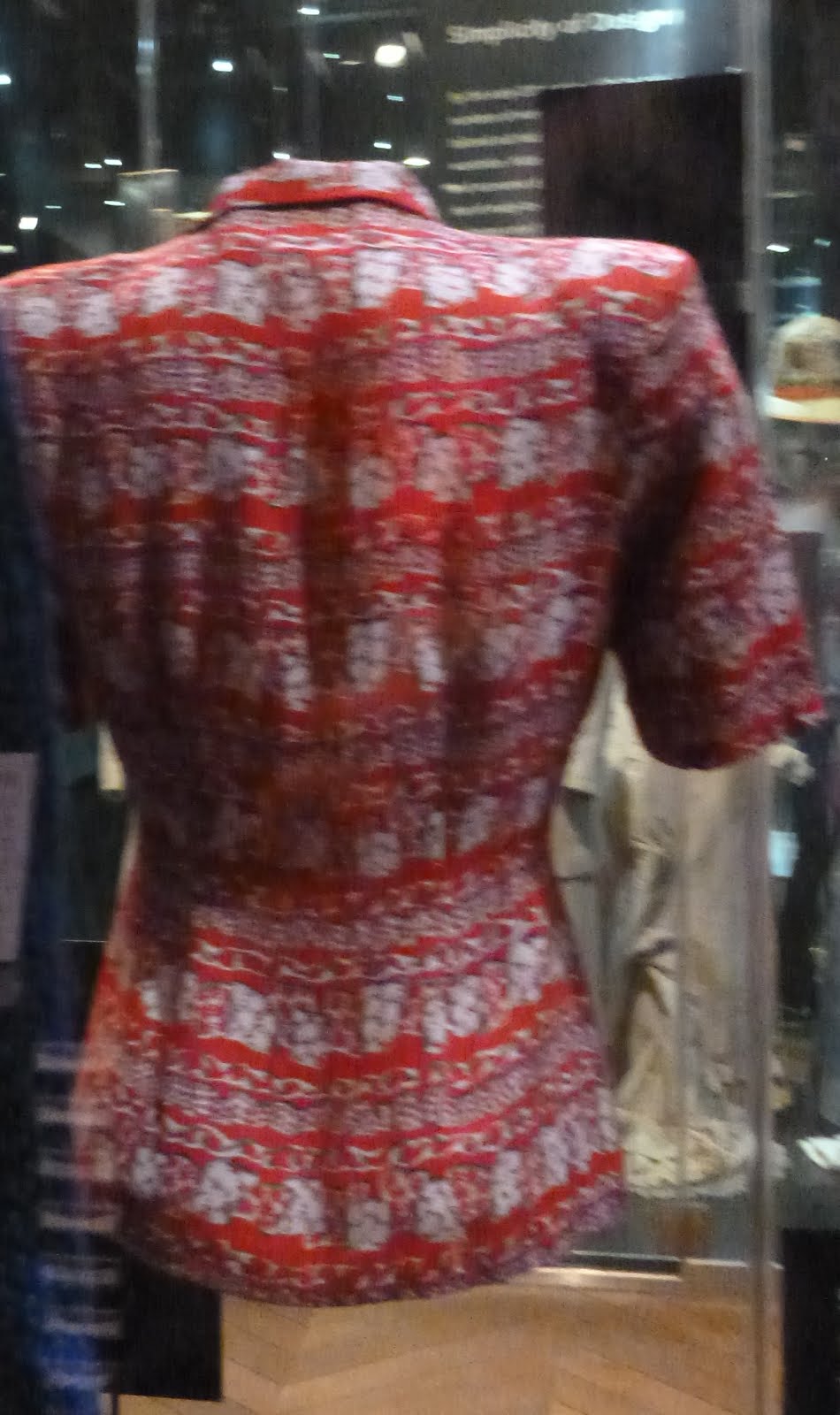
Utility blouse 1941-8


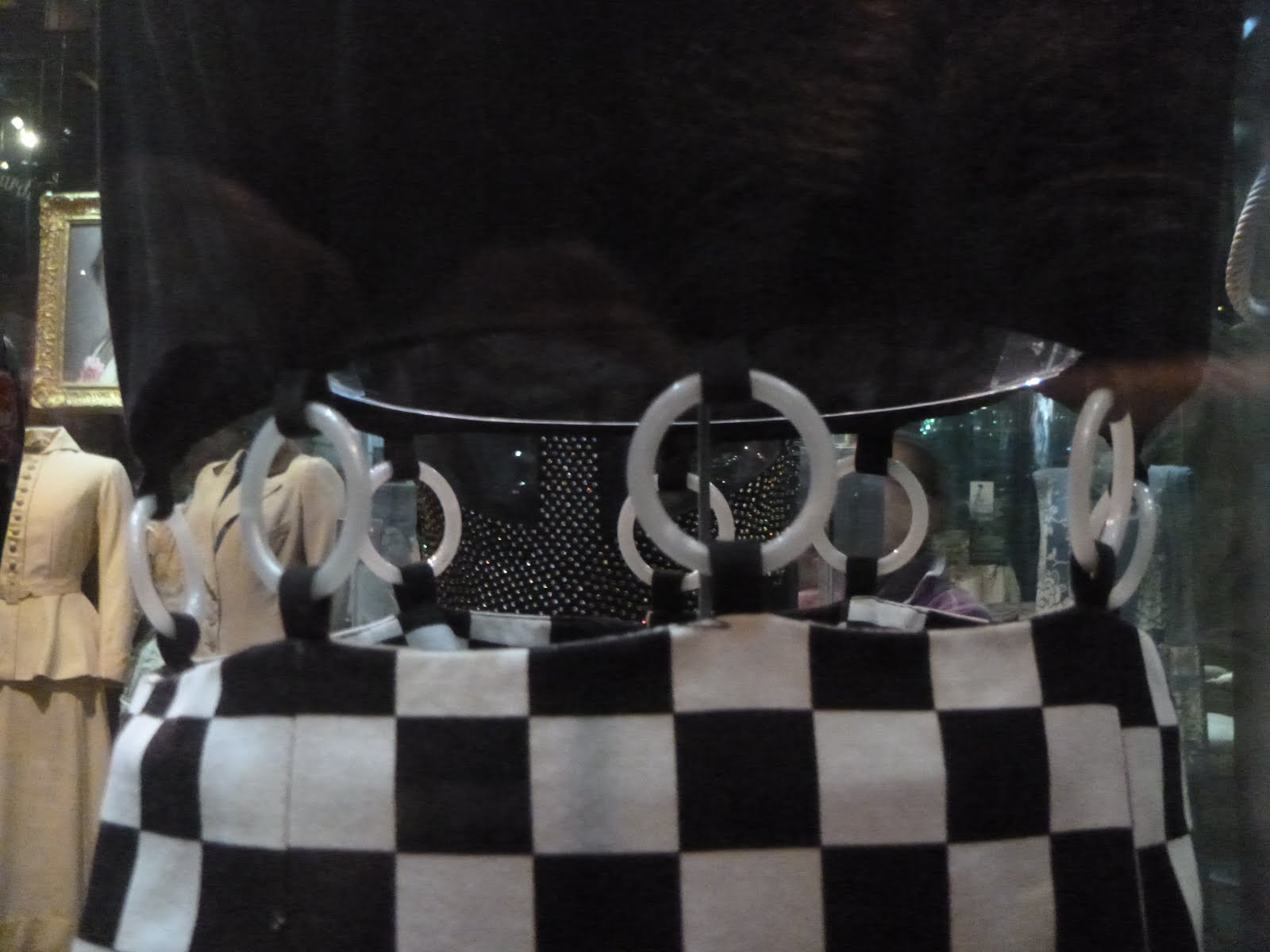
1964 Jean Varon (John Bates)

c1965

I often just walk through a museum to get to the costumes and walk straight out afterwards. At Bowes you cant do that. I was drawn into rooms filled with furniture and paintings and curios and porcelain and a very clever, very famous silver swan. Case after case full of exquisite things. Yes I know that all (most?) museums are like that, but Bowes  is really special. Light airy rooms, quiet nooks with chairs, a wealth of marble staircases, wooden floors and a great sense of space.
And there is still another story to tell from Bowes…the history of Joséphine Bowes and her husband John. The tale of his enormous wealth, a life in Paris, meeting an actress, their love story, a marriage and a zeal for collecting that all came together with their great vision for a museum.  All this is beautifully depicted and described within the museum, along with some eye watering bills from Worth in Paris ‘ 1st June 1872, Bill for Mme Bowes’ ‘Dress in gauze and lace, Scarf in white crêpe de chine and Valenciennes lace’ etc etc, to a total of 11,184.00 Francs. (£36k today)

Tying the two areas of costume and founders together is a replica of a dress worn by Joséphine Bowes, taken from her portrait and meticulously recreated by Luca Costigliolo. A video of its construction shows in the costume space.


Bowes is exceptional. I have wanted to visit this museum for years.
It did not disappoint.


22 April 2017

TRAINS AND TEXTILES


Spending time at 
TRAIN WORLD 
in Brussels

(trainworld.be) 

wouldn't usually result in a post to my blog. 


But gentle reader, there were gems to be found. 

Yes, there were trains. 
Lots and lots of trains.


But there were also some of the most fetching reproduction 1960s textiles and wallpapers I have seen for a while. And by going even further back in time, (sadly with regard to the exhibits only. I was in the 21st century the entire time) I saw train compartments featuring delicate and beautiful marquetry as part of their decor.


The genius thing here was the replica of the crossing keepers house nestled in the middle of the museum. Not only did it show how close to the tracks and how noisy their life must have been, it showcased a fab selection of textiles and wallpapers. The living room had gorgeous curtains, and on closer inspection (This inspection causing a museum guard to stride purposefully towards me...perhaps she thought I was going to make a dress out of them?) revealed that they had been woven by Arthur Sanderson and Sons. Various colours and patterns made the rooms jolly and attractive and very ‘60s.  My photos are dark, as the light levels were low. But I think enough is recognisable to be worth posting.


Living Room Curtains


Wallpaper


What the travellers wore and did whilst on the train that thundered past the crossing keepers cottage was beautifully displayed in another exhibit. 

This was a (thankfully) well lit 1960s commuters carriage, dressed with a MANS business essentials of the day, a typewriter, a filofax (est.1921), plus a cup and saucer. And of course his jacket, hat, spectacles and wallet.


Across the aisle were the female commuter's accoutrements. She  had left her jacket, hat, gloves and scarf by her seat, her chic handbag was at her side. Her magazine was left open on the table, along with her notepad and pencil, which was poised to carry on with her jottings. A modish tartan bandbox was perched on the luggage rack, packed no doubt with a stylish change of clothes.


Further back in train time, a belle époque sleeping compartment illustrated comfort and luxury from a lost era. 


Further examples of marquetry used in train compartments of the time were displayed alongside.


The exhibition halls were new, spacious and well laid out. Light levels were more in keeping with a textile display, but it did contribute to the overall atmosphere.

Le style industriel made for a clean clear backdrop to the walkways and staircases.


Visitors were shown out very promptly at closing time. I found out why in the next day's newspaper report of a visit by the King of Belgium and two of his children to Train World  the day before. No wonder they wanted to empty the place tout suite. 
Proof, if it were needed, that what I do today……..


30 March 2017

Just Married in Brussels


1945
Costume and Lace Museum
Brussels March 2017

A favourite museum in one of my favourite cities.
The current exhibition is ‘A History Of Marriage’

There are cases full of dresses from someone’s dream day. At least I hope so.


I began my visit gazing at a rare white 1830s gown that looked so tiny yet had such big sleeves. The scalloped skirt frill and hem were lovely. This is the hardest kind of dress for me to actually imagine someone wearing. It reminds me of the doll in Coppélia.1875 and the ruching, ruffles, frills and lace on show exactly matched  the description of ‘excessive ornamentation’ (designed to mimic the style of upholstery of the time).Wax flowers worn as a corsage on the shoulder sat well above a lot of draping and swathing from 1890. A blizzard of ivory and white, satin, tulle and chiffon took me through 1895 with its high necked, tiny waisted, tight sleeved confection with a long train would have meant movement was at best minimal and at worst impossible.
As this is the lace museum the wedding hankie on shown was perfection. These hankies were a very important accessory for an elegant bride in the 19th century, often decorated with the husband to be and the brides initials. There was a dress from c1910 that reminded me of the style of the late Queen Elizabeth The Queen Mother. It looked fragile and lovely in ivory damask silk with chiffon sleeves and embroidered pearls. The treats just kept on coming. Irish lace and braiding on  an ivory woollen 1910 dress.

Then ivory satin from 1949, quite like a riding outfit from the 18th century. More ivory satin from 1957, this one sparkling in strass and pearls. A dress inspired by Schiaparelli and made in ivory silk satin by the bride and her sister in 1948 had the most dramatic slash of fabric falling from right to left on the skirt. It worked perfectly as the rest of the dress was so stark. Declaring an interest here. I got married in the 1970s. My choice of medieval sleeves seemed spot on then and if Game of Thrones ever need an extra, I’m there. Representing this era, (one that has come into such criticism,mainly from people who have no memory of what the 1980s were like)…were huge bishop sleeves on a flowing white creation from 1973. It had a few random daises strewn across it. Very simplistic but a little bare I thought, as it looked as if they only had a few daises to spare. As I say, The Eighties. 19 not 18. Well. The example of high fashion for that era was in the style of a pair of hair salon curtains in bright white nylon. A long ruched neck to hip top, then two big flounces. Plus some puffy long sleeves. I can’t rule out shoulder pads. I rest my case.
1830s

1875

1895


1890

c1910


1910
1910
1948
     
1957


1973 & 1980s
John Galliano s/s 2010


1775-1760


1907
1907


The centrepiece gown was a Galliano s/s 2010 HC gown composed of a long sleeved corset style top with attached suspenders and a skirt of feathers over a crinoline shape. The top was white and that was about the only thing weddingy about it in my opinion. Definitely JG in his other worldly dramatic phase. Tucked away in a corner was a blue 1755-1760 Mantua style gown in silk lampas. The notes report that it was difficult to say whether a dress was specifically a wedding dress from this period, but as the whole underskirt is rich fabric and not merely the bits that show, it seems probable that it was. The mannequin was wearing a lace cap with lappets and the notes said that some people were of the opinion that veils had originated from this cap style. I do see what they mean. There was a black dress chosen by an 1858 bride for its practicality post wedding. And a red shot silk taffeta and organza dress from 2000 that looked straight out of a gothic novel. My favourite was a dress that was part of a trousseau, not an actual wedding dress. Borrowing heavily from the First Empire this perfectly lovely dress in white crêpe de chine glittered and sparkled with pearls, silver thread and beads. It belonged to Princess Marie Bonaparte who married her Prince in 1907. The creation of Parisian House Drecoll, it was part of a trousseau that featured 108 pairs of shoes and eighty, yes eighty evening dresses.
Brussels must have a great store of the artefacts that give us a back story and dress the cases to perfection. Each exhibition, whatever the theme, has exquisite pieces. Their collection of contemporary documents and background literature must be huge.
One case had a Bridal Set from the 1880s. This consisted of a box with one large and one small flounce and a matching hanky, all in Point de Gaze lace. The names of all the brides who had worn the lace were embroidered on the ribbon that held the lace in the box. Anne 1885. Ghislaine 1909. Marguerite Daisy 1938. ( As any fule kno, Marguerite is the French for daisy. I wonder why she had both names?)
Several aphorisms on the subject of marriage were written on the walls of the ladies cloakroom. Sadly my nerve failed me from venturing into the Gents to see if they had anything similar.
So the last word shall go to Oscar Wilde.

‘Le Mariage est la cause principale du divorce’


All photographs from Brussels Museum.
Bridal Set